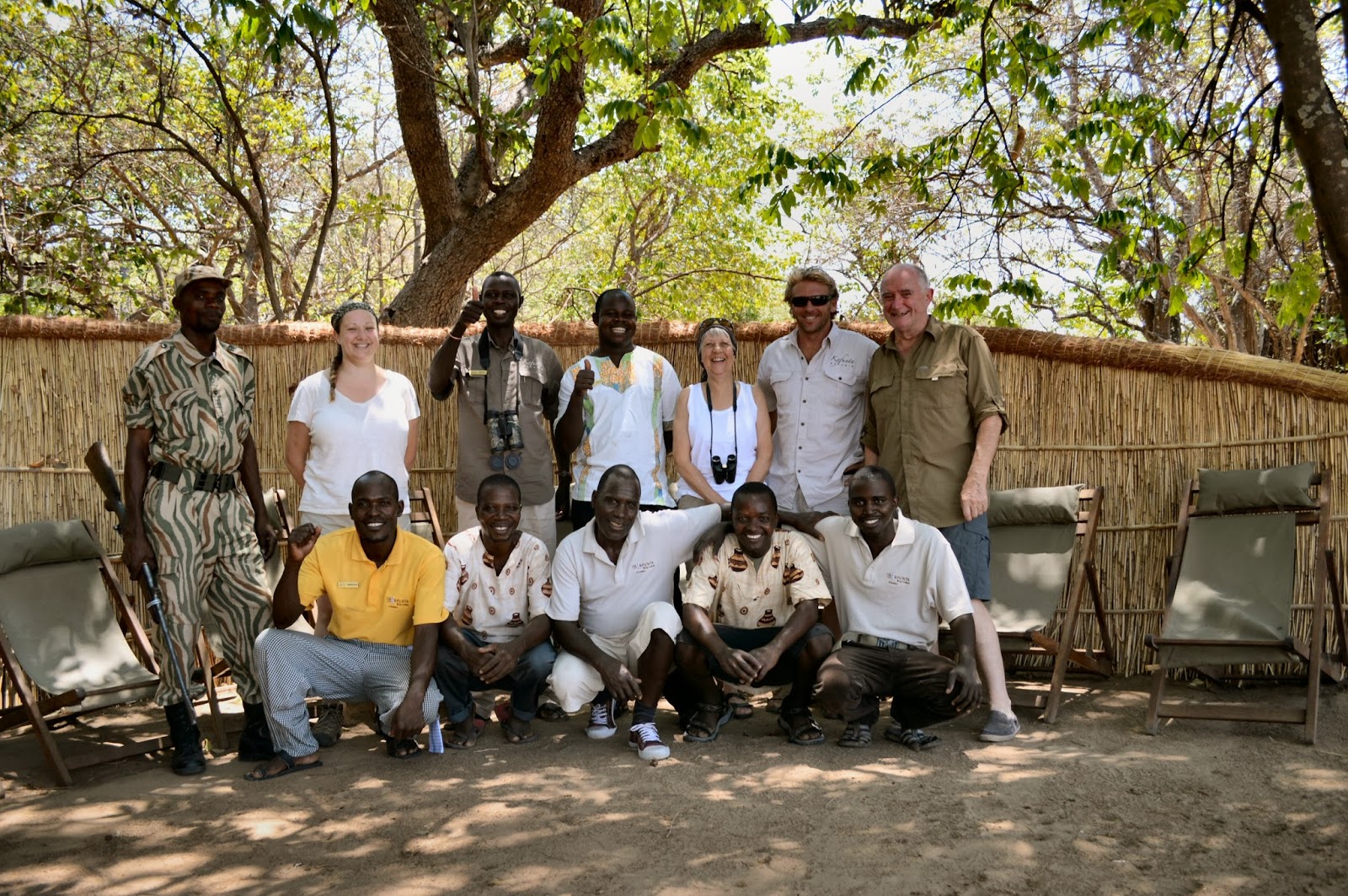
We’re settled in at Flatdogs Lodge for three days, a very different safari experience from Kafunta, although only a few miles down river.
We’ve the Jackaberry Treehouse as accommodation, an open, two-bedroom and lounge arrangement perched four meters from the ground around three mature trees, overlooking a waterhole. In fact, our very own animal-hide.
The water hole attracts all kinds of wildlife at dawn. First to arrive just as the sun peeks over the horizon are the giraffes. They approach very cautiously, watchful for predators. Their drinking stance is their most vulnerable position, and lions know this!
Meanwhile a Goliath heron flies silently overhead, ignored by the waterhole inhabitants
Finally the whole family arrives as other animals start to make their appearance.
Sacred Ibis and Yellow-billed Stork, Vervet monkey, baboons.
All so easy to watch from our vantage point.
Baboons demonstrate their vulnerability whilst drinking, but the Hamerkop doesn’t seem worried. Meanwhile the two newest members of the giraffe family make their appearance.
Finally the elephants, for whom we learned the collective is 'parade', not herd, make their appearance while the giraffes make way for them to take their turn. There seems to be definite water-hole etiquette. The Impala and Waterbuck fit in wherever they can.
Later we’re out on a driving safari, after the worst heat of the day. Flock of Lovebirds – how can people cage these sweet birds – red-billed hornbills, crested Guineafowl. Plenty to help each other watch as we stop for a sundowner.
Then finally, on the way back to the lodge, a chance encounter with an Verreaux’s (Giant) Eagle Owl, the largest of its species in the World!
Thursday, November 7, 2013
28th October
An early start to the day, becoming normal to wake and rise by 5.30am. Most get their work done before the heat sets in around 10am. We really don’t know how lucky we are. Drawing your water from the communal well each day is normal for most folks . . .all we do is turn a faucet!
Even the Lilac-brested Roller, locally called the rainbow bird for it combination of seven beautiful feather colours, is a good example of the early bird getting the worm, or in this case, snake.
The Baobab tree, also know as the upside-down tree for the way its branches resemble roots. Majestic, and massive.
On our drive back from the bush camp to Kafunta Lodge . . .elephants. Love ‘em! Poaching for ivory is an increasingly horrendous problem throughout Africa, but positive steps being made within the parks to stem the killing.
The African Jacana, a wader, and common in the areas we visited.
Back at the Lodge, farewell to our waiter Steve, before we head onto Flatdogs.
Even the Lilac-brested Roller, locally called the rainbow bird for it combination of seven beautiful feather colours, is a good example of the early bird getting the worm, or in this case, snake.
The Baobab tree, also know as the upside-down tree for the way its branches resemble roots. Majestic, and massive.
On our drive back from the bush camp to Kafunta Lodge . . .elephants. Love ‘em! Poaching for ivory is an increasingly horrendous problem throughout Africa, but positive steps being made within the parks to stem the killing.
The African Jacana, a wader, and common in the areas we visited.
Back at the Lodge, farewell to our waiter Steve, before we head onto Flatdogs.
27 Oct 2013
Our last full day at Island Bush Camp. The time is already beginning to fly, as we get acclimatised---getting up and going to bed with the sun.
Waking to hippos playing in the river just below us seems so normal.
African buffalo . . .look like cattle to me . . . but totally wild, sometimes dangerous, and one of the ‘big five’ : lion, leopard, rhino, elephant and buffalo. So named because in the early days of colonization, these were the five most dangerous animals to hunt, and bring home as trophies to hang on the wall. Nowadays, most hunt with cameras.
Could be somewhere in rural Ontario . . . except for the giraffe, and warthog!
Not the kind of guy you’d want to butt heads with.
The Bush Camp dining room, the Bush Camp crew who made our stay so pleasurable: the kitchen and chef Mathews, who catered to our needs and produced amazing meals, and Martin, who guided to sights and sounds we’re never likely to forget from this corner of Zambia.
Waking to hippos playing in the river just below us seems so normal.
African buffalo . . .look like cattle to me . . . but totally wild, sometimes dangerous, and one of the ‘big five’ : lion, leopard, rhino, elephant and buffalo. So named because in the early days of colonization, these were the five most dangerous animals to hunt, and bring home as trophies to hang on the wall. Nowadays, most hunt with cameras.
Could be somewhere in rural Ontario . . . except for the giraffe, and warthog!
Not the kind of guy you’d want to butt heads with.
The Bush Camp dining room, the Bush Camp crew who made our stay so pleasurable: the kitchen and chef Mathews, who catered to our needs and produced amazing meals, and Martin, who guided to sights and sounds we’re never likely to forget from this corner of Zambia.
Wednesday, November 6, 2013
26/27 October 2013
Moved from the comforts of Kafunta Lodge to the Island Bush Camp for three nights. Overlooking the Luangwa River, right now one of the few water sources for wildlife during the dry season.
Up with the sun, and out early into the bush on a walking safari, up close and personal, with out own park ranger, armed, just in case.
Plenty of animals, and birds. The African fish eagle, national bird of Zambia.
A hippo family we surprised, making a run for it!
Impala and a Golden Bridge Stork, all using the River.
Cicadas by the bucketload, all adding their tunes to the noise of the bush.
. . .and of course, giraffe and elephant.
Then back to camp by 9am, a long siesta in the heat of the day, and out on evening safari when the sun starts to sink and it cools off a bit. Baboons everywhere, and not to forget looking at trees, the sausage tree providing for all kinds of animals, as well as humans.
Down to the riverbed for a sundowner, while we watch the hippos and compare photo techniques.
Up with the sun, and out early into the bush on a walking safari, up close and personal, with out own park ranger, armed, just in case.
Plenty of animals, and birds. The African fish eagle, national bird of Zambia.
A hippo family we surprised, making a run for it!
Impala and a Golden Bridge Stork, all using the River.
Cicadas by the bucketload, all adding their tunes to the noise of the bush.
. . .and of course, giraffe and elephant.
Then back to camp by 9am, a long siesta in the heat of the day, and out on evening safari when the sun starts to sink and it cools off a bit. Baboons everywhere, and not to forget looking at trees, the sausage tree providing for all kinds of animals, as well as humans.
Down to the riverbed for a sundowner, while we watch the hippos and compare photo techniques.
Subscribe to:
Posts (Atom)